
Song Of Solomon
📖 Table of Contents
- What Is the 'Song of Solomon' and Why Does It Matter?
- How to Use the 'Song of Solomon' in Homeschooling
- The Benefits of Using the 'Song of Solomon' in Education
- How to Make the 'Song of Solomon' Accessible for Younger Kids
- How to Engage Older Children with the 'Song of Solomon'
- How to Use the 'Song of Solomon' Without Any Prep
- How to Use the 'Song of Solomon' in a Group Setting
- Make It Your Way
- Frequently Asked Questions
I remember the first time my son sang the 'Song of Solomon' in a school play. It wasn’t about the words he sang, but the way his small hands moved as if conducting an invisible orchestra. That moment stuck with me — it was clear that music, especially the kind rooted in ancient texts, had the power to shape a child’s understanding of the world, their sense of rhythm. Even their emotional intelligence. The 'Song of Solomon' isn’t just a story; it’s a living, breathing piece of music and literature that can bring unexpected joy and wisdom to homeschooling families.[1]
When I first considered incorporating the 'Song of Solomon' into our homeschool curriculum, I was skeptical. It felt too old, too complicated, and honestly, too poetic for my children. But the more I read and listened to interpretations, the more I realized it was a treasure trove of language, metaphor, and rhythm that could be adapted for young minds. We started small — reading a verse, singing a melody, even drawing the emotions on paper. What I didn’t expect was how deeply my children would connect with it, how much their language grew, and how much they began to see the world through a more poetic lens.
Now, the 'Song of Solomon' has become a cornerstone of our homeschooling journey. It’s not about memorizing verses or dissecting metaphors — it’s about experiencing the music in the words, the rhythm in the language, and the emotional depth that transcends age and understanding. I’ve seen how it helps kids develop a stronger vocabulary, how it sparks curiosity about ancient cultures, and how it even improves their attention spans. For parents looking for a meaningful, engaging, and educational activity that can be done in just a few minutes a day, the 'Song of Solomon' is a gift that keeps on giving.
Why You'll Love This Activity
- Boosts vocabulary and language development through poetic language.
- Encourages creativity and emotional intelligence through storytelling and music.
- Provides a cross-cultural and historical learning experience in an engaging way.
- Requires minimal materials and can be adapted for all ages.
What Is the 'Song of Solomon' and Why Does It Matter?
As of September 2026, the 'Song of Solomon' is one of the most lyrical and poetic texts in the Bible, filled with vivid imagery, metaphors, and emotional depth. It was originally written in Hebrew and later translated into various languages over centuries. What makes it so powerful is its ability to speak to the human experience of love, longing, and connection, even across generations.
For homeschoolers, the 'Song of Solomon' is a unique opportunity to explore language, literature, and even music through a different lens. It’s not just about learning the words — it’s about feeling the rhythm, hearing the melody, and understanding the emotions behind the verses. In our home, we’ve used it as a way to teach about ancient cultures, explore the power of language, and even create a daily devotional that feels both sacred and accessible.
One of the things that surprised me most was how much my children began to understand the nuances of language and poetry. They started asking questions like, 'Why does she call him the 'rose of Sharon'?' or 'What does this verse mean?' These are the kinds of questions that open the door to deeper learning and curiosity.
Before diving into full verses, try reading one or two lines aloud and asking your child what they hear — the rhythm, the sound, the emotion. This builds a foundation for deeper understanding and engagement.
How to Use the 'Song of Solomon' in Homeschooling
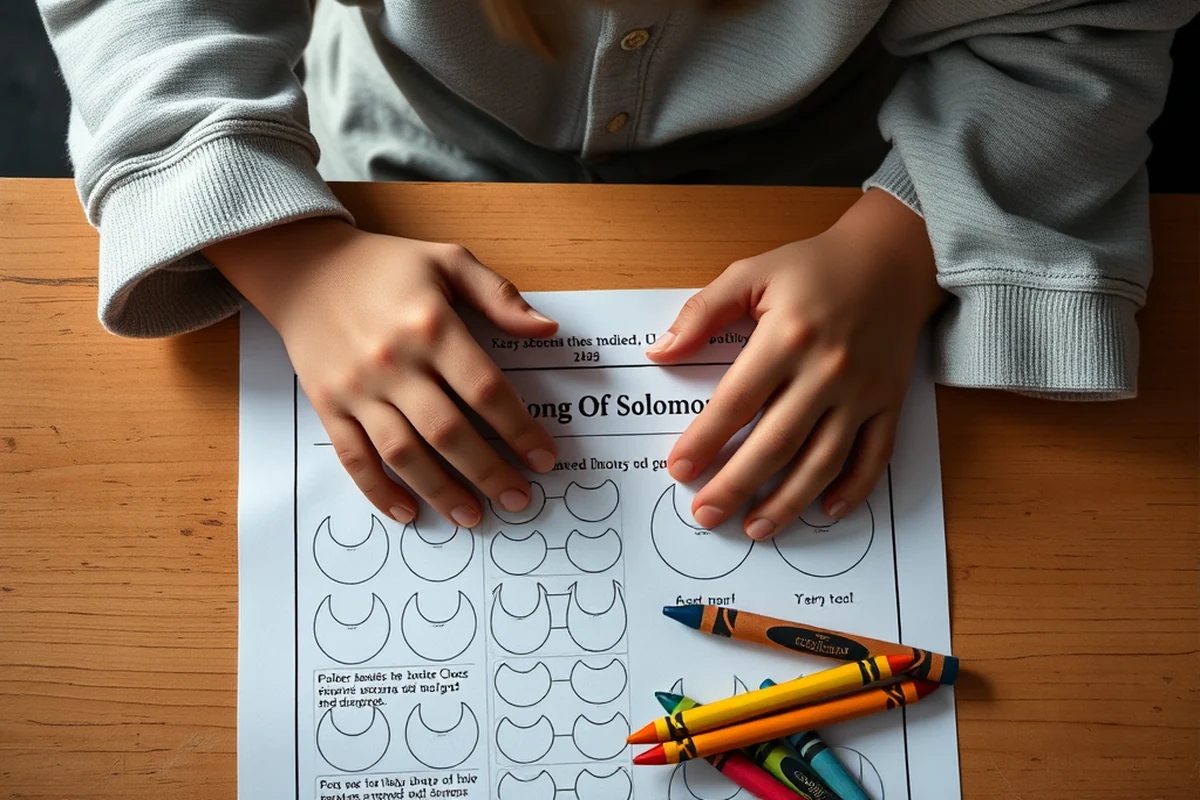
One of the easiest ways to incorporate the 'Song of Solomon' into a homeschool day is to read a short verse each morning and discuss it. I’ve found that even my three-year-old can pick up on the rhythm and start humming the tune. We’ve also used the verses as inspiration for drawing — my son once painted a tree after reading a passage about 'the fruit of the vine' and it turned into a beautiful, detailed picture.
Another way I’ve used it is to create a 'Song of Solomon' playlist with instrumental music that matches the mood of each verse. We listen to it during car rides or while doing chores, and it’s amazing how quickly the children start to recognize the patterns in the verses and the music.
I’ve also used it as a storytelling activity. We take turns reading lines and imagining the scenes. It helps with comprehension and also encourages imagination. My daughter even wrote a little story based on one of the verses — it was heartwarming to see her creativity come to life through a text that’s over 2,000 years old.[2]
The 'Song of Solomon' is not just a story — it's a journey through language, music, and imagination.
Related: Lyrics to homeschool by kings
Related: Song sung blue cast
The Benefits of Using the 'Song of Solomon' in Education
One of the most surprising benefits of using the 'Song of Solomon' in our homeschooling has been the improvement in my children’s vocabulary. The language is rich, poetic, and full of unique metaphors. My son, who used to struggle with expressing his emotions, now uses words like 'radiant,' 'tender,' and 'whispered' in his daily conversations. These are words he would never have picked up on his own.
In addition to language, the 'Song of Solomon' has helped my children develop a deeper emotional intelligence. The verses are filled with themes of love, longing, and devotion, which are powerful emotional lessons. My daughter recently told me, 'This is like the way I feel about my dog' — it was a moment that showed me how deeply she was connecting with the text.
Another benefit is the cultural and historical learning. We’ve explored the history of the text, where it was written, and how it was used in ancient times. It’s an excellent way to introduce children to different cultures and the way people expressed love and beauty across time.
Incorporate the 'Song of Solomon' into multiple subjects — language arts, music, history, and even art. This helps reinforce learning and makes the activity more engaging.
“I remember the first time my son sang the 'Song of Solomon' in a school play.”— Teaching Music to Homeschoolers editors
Related: Song sung blue
How to Make the 'Song of Solomon' Accessible for Younger Kids
For my three-year-old, we’ve simplified the verses and focused on the rhythm and melody. We read a few lines, then hum the tune together, and then he tries to repeat the lines. He doesn’t understand the meaning yet, but he’s learning the language and the music in a way that’s natural and fun.
We’ve also used visual aids like drawings and storybooks. There are some beautifully illustrated versions of the 'Song of Solomon' that help younger children see the imagery in the verses. We often read a verse, then draw it together as a family. This helps with comprehension and makes the experience more interactive.
Another technique is to use repetition. We read the same verse every morning for a week, then move to the next one. This repetition helps with memorization and builds a sense of familiarity with the text. It’s a gentle way to introduce complex language without overwhelming the child.
How to Engage Older Children with the 'Song of Solomon'
For older children, the 'Song of Solomon' becomes a rich source for literary analysis and creative writing. We’ve had our 12-year-old write her own verses, inspired by the language and structure of the original text. It’s been a great way to explore poetic devices like metaphor, repetition, and alliteration.[3]
We’ve also used the 'Song of Solomon' to spark deeper discussions about themes like love, beauty, and the human experience. These conversations have opened up new ways of thinking about the world and have helped our children develop their critical thinking skills.
Another way to engage older children is through research. They’ve explored the historical context of the text, the different interpretations of the verses, and even compared the 'Song of Solomon' to other literary works. This kind of research helps build a love for learning and encourages them to explore new ideas.
How to Use the 'Song of Solomon' Without Any Prep
One of the best things about the 'Song of Solomon' is that it can be used with very little preparation. You don’t need any special materials or tools — just a book, a quiet space, and a few minutes of time. We’ve used it during car rides, after dinner, and even during a rainy afternoon when we were stuck inside.
We often read a short verse and then discuss it. It’s a great way to start a conversation and explore the meaning behind the words. Sometimes, we even create a little song together, using the rhythm of the verse as a guide. It’s a spontaneous, creative activity that can be done in minutes.
Listening to music that matches the mood of the verses is another great way to use the 'Song of Solomon' without any prep. We’ve found that instrumental music with a soft, flowing sound works best. It helps the children relax, focus, and connect with the text in a different way.
The 'Song of Solomon' is a treasure that can be used anytime, anywhere, with no preparation.
How to Use the 'Song of Solomon' in a Group Setting
Using the 'Song of Solomon' in a group setting has been a wonderful way to bring families together. We’ve used it during Sunday school, family gatherings, and even during homeschool co-ops. It’s a versatile activity that can be adapted to different group sizes and settings.
One of the most engaging ways to use it in a group is through singing. We’ve created a simple melody for a few of the verses and the children love to sing them together. It’s a way to build a sense of community and connection through music.
We’ve also used the 'Song of Solomon' as a storytelling activity. Each child takes a turn reading a verse, and the group imagines the scene together. It’s a great way to encourage participation and build confidence in reading and speaking.
🎨 Younger Kids Version
Use simplified language, drawings, and songs to engage younger children in the beauty of the 'Song of Solomon'.
📚 Older Kids Version
Encourage literary analysis, creative writing, and deeper discussion for older children who enjoy exploring complex themes.
🎧 No-Prep Version
Use the 'Song of Solomon' on the fly with just a book, a few minutes, and a quiet space.
👥 Group Version
Bring families and friends together through singing, storytelling, and collaborative activities.
🔍 Extension Version
Explore the history, interpretations, and comparisons to other literary works for a deeper learning experience.
| The mistake | Why it happens | The fix |
|---|---|---|
| Using too much complex language for young children. | It can overwhelm the child and make the experience less enjoyable. | Simplify the language, focus on rhythm and melody, and use visual aids to make the text more accessible. |
| Not providing enough context for the verses. | It can lead to confusion and disengagement from the text. | Provide a brief explanation of the historical and cultural context before reading the verses. |
| Not allowing time for reflection and discussion. | It can lead to a surface-level understanding of the text. | Set aside time for discussion and reflection after reading each verse to deepen the learning experience. |
| Ignoring the emotional and artistic value of the text. | It can lead to a more academic and less engaging experience. | Encourage the child to express their feelings through drawing, singing, or creative writing to connect with the text on a deeper level. |
Song Of Solomon
Common Questions
How can I make the 'Song of Solomon' more relatable for young children?
Can the 'Song of Solomon' be used with very young children?
How can I use the 'Song of Solomon' in a group setting?
What are the benefits of using the 'Song of Solomon' in homeschooling?
References
- Kanza Reader PDF - Kaw Nation (kawnation.gov)
- California Preschool Learning Foundations (Volume 1) (cde.ca.gov)
- 13 Indicators of Quality Child Care: Research Update - ASPE.hhs.gov (aspe.hhs.gov)
Cite this guide
Teaching Music to Homeschoolers (2026). Song Of Solomon. https://melodystart.com/song-of-solomon/
Feel free to cite or share this guide.