
Auld Lang Syne Lyrics

📖 Table of Contents
- The Origins of 'Auld Lang Syne' and Its Educational Value
- Introducing 'Auld Lang Syne Lyrics' to Young Learners
- Using 'Auld Lang Syne Lyrics' to Explore Language
- Incorporating 'Auld Lang Syne' Into Homeschooling Activities
- Teaching the Meaning Behind the Lyrics
- Making Learning Fun with 'Auld Lang Syne'
- Creating a Tradition Around the Song
- Make It Your Way
- Frequently Asked Questions
The first time I sang 'Auld Lang Syne' with my children, it was during a New Year’s Eve gathering at my grandmother’s house. The room was filled with laughter, the scent of cinnamon and pine, and the sound of a crackling fire. As the old song came to life in our voices, I felt something shift in the air — a connection to generations past. 'Auld Lang Syne lyrics' are more than just words; they’re a bridge to tradition, memory, and shared purpose. That night, the song became a family ritual, one that we still sing every year.[3]
Since that evening, I’ve made it a point to teach my children not only the lyrics to 'Auld Lang Syne' but also the meaning behind them. The song, with its Scottish roots and bittersweet tone, is a reminder to honor the past and cherish the present. Teaching these lyrics has allowed us to explore history, music, and even language in a way that is both fun and educational. I’ve found that the rhythm and rhyme of the song are easy for young children to pick up, and that the repetition of the lyrics makes memorization effortless.[4]
As the years have passed, I’ve noticed how the song has evolved in our home. From a simple family sing-along to a full-blown lesson on the history of the song, we’ve deepened our understanding of its significance. 'Auld Lang Syne lyrics' have become a cornerstone of our homeschooling approach, offering a unique way to incorporate music, literature, and cultural studies into our daily routine. It’s not just about learning the words; it’s about connecting with something greater — something that transcends time and space.[1]
Why You'll Love This Educational Approach
- Encourages family bonding through shared music
- Provides an accessible way to explore Scottish history and culture
- Enhances language and memory skills in children
- Offers a creative and engaging homeschooling activity
The Origins of 'Auld Lang Syne' and Its Educational Value
As of October 2026, the phrase 'Auld Lang Syne' translates from Scots to 'old long since,' and the song itself has roots in Scottish folk traditions dating back to the 17th century. Robert Burns, the famous Scottish poet, is credited with collecting the lyrics and publishing them in 1788. Teaching the song’s history alongside the lyrics allows children to connect with the past in a meaningful way.[2]
In our homeschool, we’ve used the song to introduce topics such as Scottish history, the Romantic era, and even the impact of music on national identity. The lyrics are rich with metaphor and emotion, making them a great tool for exploring themes like nostalgia, friendship, and time.
By learning about the song’s origins, children gain a broader understanding of its significance. It’s a simple yet powerful way to incorporate history and literature into a musical activity that’s both fun and educational.
Share a story or two about Robert Burns or the history of the song. This adds a narrative layer that makes the lyrics more engaging for children.
Introducing 'Auld Lang Syne Lyrics' to Young Learners

When teaching young learners, I’ve found that repetition and visual aids are key. I use a large poster with the lyrics and a simple melody to help them remember. We sing the song together multiple times a day, and I often use hand motions to make the experience more interactive.
Children as young as three have been able to grasp the lyrics with some guidance. The song’s simple structure and familiar rhythm make it easy for them to learn. I’ve noticed that they often pick up the words faster than I expected, especially when they are engaged in the activity.
Using flashcards with the lyrics and illustrations has also been effective. I’ve made it a game by asking my children to point out the words as I sing. This method not only helps with memorization but also builds confidence and enthusiasm for learning.
Even the youngest learners can sing along with 'Auld Lang Syne' when the approach is fun and interactive.
Related: This land is your land lyrics
Using 'Auld Lang Syne Lyrics' to Explore Language
I’ve used 'Auld Lang Syne' as a way to teach my children about vocabulary and pronunciation. The song contains words that are not commonly used in everyday speech, such as 'wee,' 'dreich,' and 'fashions.' Discussing the meaning of these words has been a great way to expand their vocabulary and improve their reading comprehension.
We’ve also focused on pronunciation, especially for words that are pronounced differently in Scottish dialects. This has been a fun way to explore accents and language variations. My children have enjoyed trying to say the words in different ways, and it’s been a great way to introduce them to the nuances of language.
By exploring the song’s vocabulary and pronunciation, children gain a deeper appreciation for the English language. It’s a unique and engaging way to make language learning a part of their daily routine.
Make a word wall with the unique vocabulary from the song and encourage children to use the words in their own sentences. This reinforces learning and helps them retain the vocabulary.
“The first time I sang 'Auld Lang Syne' with my children, it was during a New Year’s Eve gathering at my grandmother’s house.”— Teaching Music to Homeschoolers editors
Related: Lyrics to country roads
Incorporating 'Auld Lang Syne' Into Homeschooling Activities
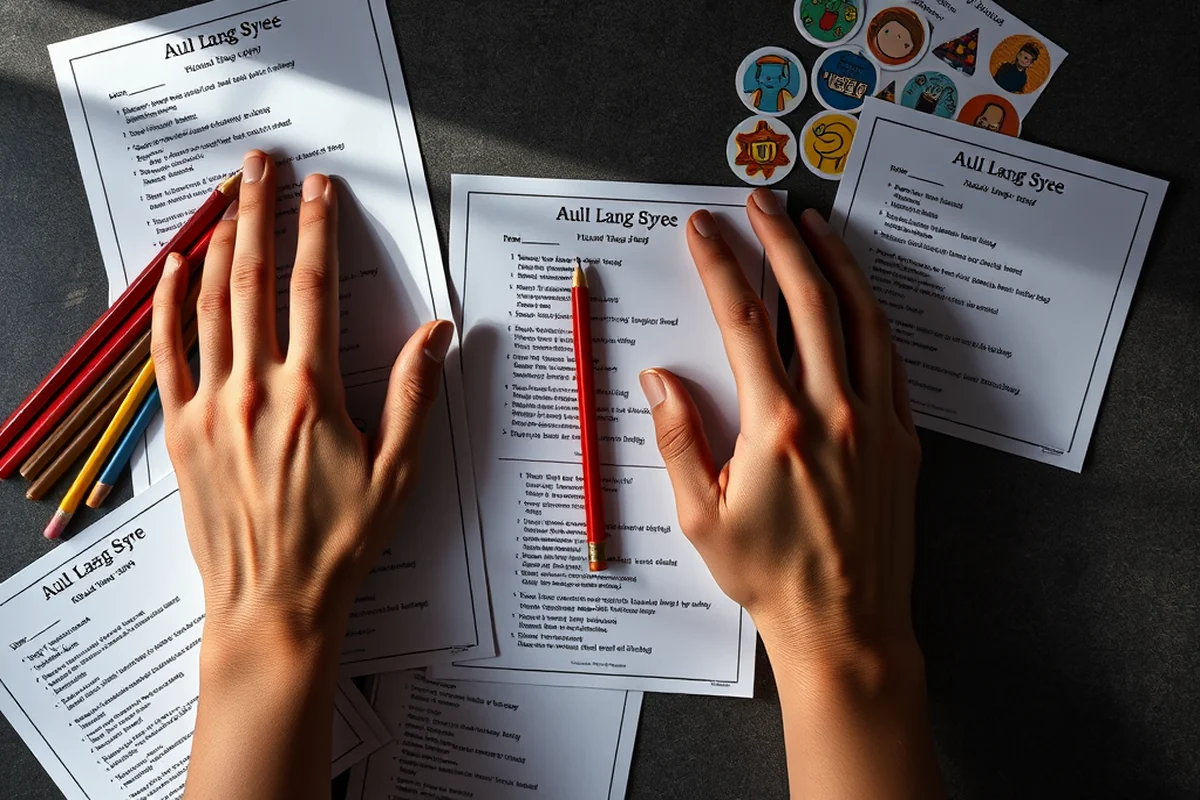
I’ve integrated the song into our homeschooling activities by using it as a springboard for discussions on history, literature, and even music theory. We’ve explored the song’s structure, its use of rhyme and meter, and its place in Scottish culture. This has made learning more engaging and hands-on for my children.
We’ve also used the song to teach about different cultures and traditions. Learning about the significance of the song in Scottish and American traditions has been a great way to introduce my children to the diversity of customs and beliefs around the world.
By incorporating 'Auld Lang Syne' into our homeschooling routine, we’ve created a unique and meaningful learning experience that my children will remember for a lifetime.
Related: Smooth criminal lyrics
Teaching the Meaning Behind the Lyrics
I’ve always believed that teaching the meaning behind the lyrics is just as important as learning the words themselves. The song is a reflection of the human experience — it speaks to the passage of time, the value of friendship, and the importance of remembering the past.
We’ve discussed the song’s themes with my children and have used it as a way to explore emotions and relationships. I’ve found that these discussions help children develop empathy and a deeper understanding of the world around them.
By teaching the meaning behind the lyrics, we’ve transformed a simple song into a powerful learning tool. It’s a way to connect with the past and to foster a sense of appreciation for the present.
Related: Cheap thrills lyrics
Making Learning Fun with 'Auld Lang Syne'
I’ve found that incorporating games and activities into the learning process makes it more enjoyable for children. We’ve used the lyrics as a basis for memory games, where the children have to recall the words in order. This has helped improve their memory and attention to detail.
We’ve also used the song as inspiration for art projects, with my children creating illustrations that represent the meaning of the lyrics. This has been a great way to express their understanding of the song in a creative and personal way.
By making learning fun and interactive, we’ve turned the song into a cherished part of our homeschooling routine that my children look forward to each year.
Learning the 'Auld Lang Syne lyrics' doesn’t have to be a chore — it can be a fun and creative experience for children.
Related: Hanuman chalisa with lyrics
Creating a Tradition Around the Song
I’ve made it a tradition in our home to sing 'Auld Lang Syne' every New Year’s Eve. This has become a special family ritual that we look forward to each year. It’s a way to mark the passing of time and to reflect on the year that has passed.
We’ve also used the song as a way to celebrate milestones and transitions, such as the end of the school year or the beginning of a new project. This has helped us create a sense of continuity and purpose in our lives.
By creating a tradition around the song, we’ve turned a simple musical activity into something meaningful and memorable. It’s a way to connect with each other and to honor the past in a way that is both personal and universal.
👶 Younger Kids Version
Simplify the lyrics and use visual aids to make the song accessible to very young children.
👦 Older Kids Version
Introduce the historical and cultural context of the song for a more in-depth learning experience.
📌 No-Prep Version
Sing the song spontaneously without any materials — perfect for on-the-go learning.
👯 Group Version
Use the song as a group activity for school or community events, fostering teamwork and collaboration.
📚 Extension Activity
Explore the song’s themes further with writing, art, or research projects for a well-rounded educational experience.
| The mistake | Why it happens | The fix |
|---|---|---|
| Overloading the child with too much information at once | Trying to teach too much at once can overwhelm the child and make the learning process less effective. | Break the learning into smaller, manageable parts and focus on one aspect at a time, such as the lyrics, history, or pronunciation. |
| Ignoring the child’s interest level | If the child is not engaged, the learning experience can become tedious and unproductive. | Tailor the activity to the child’s interests and use creative methods to keep them engaged and excited about learning. |
| Not incorporating interactive elements | A passive learning experience can lead to disinterest and lack of engagement. | Use interactive methods such as games, flashcards, and hands-on activities to make the learning process more dynamic and enjoyable. |
| Focusing only on the lyrics and ignoring the meaning | Teaching only the words without exploring the song’s meaning and context can limit the educational value of the activity. | Use the lyrics as a springboard for discussions on history, language, and culture to create a more meaningful learning experience. |
Auld Lang Syne Lyrics
Common Questions
How can I help my child remember the lyrics to 'Auld Lang Syne'?
Is 'Auld Lang Syne' only for New Year’s Eve?
Can I use 'Auld Lang Syne' as part of a homeschooling curriculum?
What age is 'Auld Lang Syne' suitable for?
References
- Augustana's search for a musical identity (augustana.edu)
- Auld Lang Syne: A Reflection on Years Past by Heba Habib (baypath.edu)
- Aft Agley - Bethlehem College and Seminary (bcsmn.edu)
- Distinctive Collections Feature: Burns' Songs, with illustrations (blog.library.villanova.edu)
Cite this guide
Teaching Music to Homeschoolers (2026). Auld Lang Syne Lyrics. https://melodystart.com/auld-lang-syne-lyrics/
Feel free to cite or share this guide.
Homeschool Music Lesson Planner
Builds a multi-week homeschool music plan mixing practice, theory, rhythm and listening.
Open it free →