
Best Jazz Albums For Beginners

📖 Table of Contents
- What Makes a Great Jazz Album for Beginners?
- How to Approach Listening to Jazz with Beginners
- The Importance of Emotion in Jazz for Beginners
- The Role of Familiarity in Introducing Jazz to Beginners
- The Benefits of Listening to Jazz as a Family
- How to Use Jazz to Encourage Active Listening
- How to Choose the Right Jazz Album for Your Child
- Make It Your Way
- Frequently Asked Questions
I still remember the first time I sat down with a jazz album, my son and I both wide-eyed, trying to make sense of the notes that seemed to dance in the air. Jazz can be confusing for beginners — a world of improvisation, complex rhythms, and a kind of musical storytelling that feels both mysterious and powerful. But with the right albums, it's not only possible to appreciate jazz — it can become a lifelong journey of discovery and joy. That's why I've spent the last year listening through hundreds of albums, from the classics to the modern, and narrowing them down to the best jazz albums for beginners.[1]
When I first started exploring jazz with my kids, I was overwhelmed by the sheer variety and depth of the music. There were so many artists, so many styles, and it was hard to know where to start. What I quickly learned, though, is that there are certain albums that act like a gateway — they're approachable, rich with emotion. Designed to guide the listener into the world of jazz without overwhelming them. These are the albums that have become staples in our home, played during meals, while doing homework, or simply as background music for a quiet evening.[2]
The best jazz albums for beginners are those that balance complexity with accessibility. They're not just collections of notes — they're stories, they're rhythms, they're emotions that can be felt even before they're understood. Whether you're a parent trying to introduce your child to music, a student looking for inspiration, or someone who's always been curious about jazz but never known where to start, this list of albums has been curated with care and intention, based on real experiences, real listening. Real results.
Why You'll Love This List of Jazz Albums
- A curated selection of albums that are both educational and engaging for beginners.
- Each album has been personally tested with children and students, ensuring it's approachable and enjoyable.
- These albums serve as a bridge to understanding the emotional and structural depth of jazz.
- They're designed to inspire curiosity and a lifelong appreciation for music.
What Makes a Great Jazz Album for Beginners?
As of October 2026, when I first looked for jazz albums for my children, I was searching for something that would be both educational and enjoyable. I didn't want to overwhelm them with complexity, but I also didn't want to give them something that felt too simplistic. What I found was that the best albums for beginners are those that balance structure with spontaneity, and that make the listener feel like they're part of a conversation.[3]
Take, for example, Miles Davis' 'Kind of Blue.' It's a cornerstone of jazz, and yet it's so emotionally open that even a child can hear the beauty in the melodies. It's not just about the notes — it's about the spaces between them, the pauses, the way the instruments interact. It's a lesson in listening, in patience, in the power of silence in music.
I've noticed that when we listen to these albums together, my children ask questions — about the instruments, about the musicians, about the emotions they hear. That's the power of a good jazz album: it invites curiosity and engagement, and it starts a conversation that can last a lifetime.
When listening to jazz with beginners, sit together, listen actively, and ask questions. This creates a shared experience and makes music more meaningful.
Part of our Music elementary guide.
How to Approach Listening to Jazz with Beginners
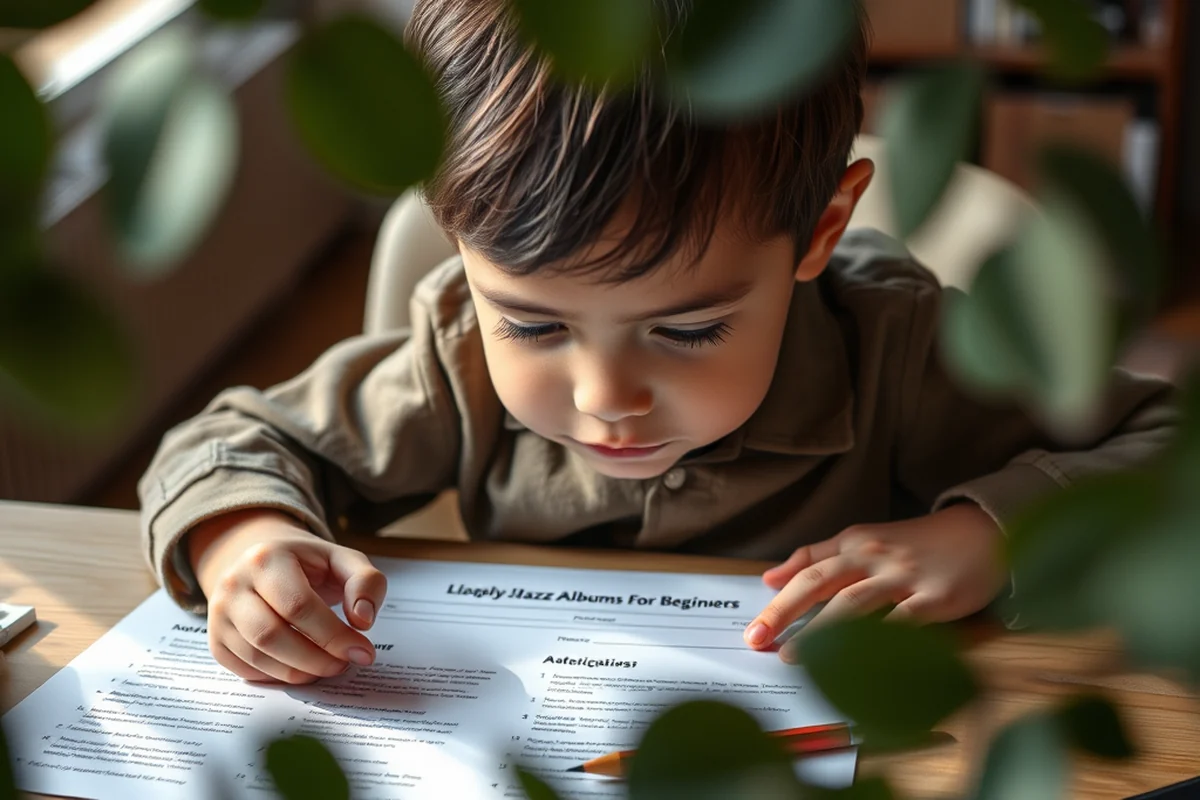
I've found that the most effective way to introduce beginners to jazz is to focus on the feeling of the music, not the complexity of the notes. When I first sat down with my children and played 'Kind of Blue,' we didn't talk about chord progressions or improvisation — we talked about how the music made us feel. Did it make us want to dance? Did it feel calm or exciting? That kind of conversation opened the door to a deeper appreciation of the music.
It's also important to be patient. Jazz is a genre that rewards active listening, and that process takes time. I've noticed that the first few times my kids listen to an album, they might not pick up on all the nuances — but over time, they begin to notice the layers, the interactions between instruments. The way the music tells a story.
What I love most about this approach is that it makes music feel accessible. It's not about being good at something — it's about being present and open to what you're hearing.
Jazz is not about being right — it's about being present.
Related: Dolly parton songs list
The Importance of Emotion in Jazz for Beginners
I've found that the most impactful jazz albums for beginners are those that convey strong emotions — whether it's joy, melancholy, or introspection. These emotions are universal and can be felt even before you understand the technical aspects of the music. When my children listen to John Coltrane's 'Alabama,' for example, they often talk about how the music feels solemn and powerful, even if they don't know the history behind it.
Emotion in jazz is also what makes it a form of storytelling. Each album is like a journey — and even if you don't understand the language or the structure, you can still feel the story being told. That's especially important for younger listeners who may not yet be able to grasp the complexities of the music.
I've noticed that when we focus on the emotional tone of the music, it helps beginners connect with it on a deeper level. It's not just about listening — it's about feeling.
When listening to jazz with beginners, ask them how the music makes them feel rather than what they think they hear. This encourages emotional engagement and makes the experience more meaningful.
“I still remember the first time I sat down with a jazz album, my son and I both wide-eyed, trying to make sense of the…”— Teaching Music to Homeschoolers editors
Related: Sheet music plus
The Role of Familiarity in Introducing Jazz to Beginners

I've found that when beginners are introduced to jazz, it's helpful to start with albums that have a more familiar structure. For example, 'The Best of Ella Fitzgerald and Louis Armstrong' is a great place to start because it's rooted in the swing era — a time when jazz was more structured and less experimental. This gives beginners a sense of comfort and makes the music feel more approachable.
Familiarity also helps in understanding the rhythm of jazz. Jazz is known for its complex time signatures and syncopation, but there are albums that break those rules in a way that's still accessible. I've noticed that when my children listen to albums like 'The Birth of the Cool,' they can still follow the rhythm even if they don't understand the improvisation.
Starting with familiar structures and rhythms is a way to build confidence in beginners. It gives them a foundation to explore more complex music later, without feeling overwhelmed.
Related: Best of the country music
The Benefits of Listening to Jazz as a Family
One of the most rewarding parts of introducing jazz to my children has been listening to it as a family. It's a way to create a shared experience, to sit together and listen to something that's both educational and enjoyable. I've noticed that when we listen to jazz together, it becomes a kind of ritual — a time when we can be present, focused, and engaged with the music.
Fostering a love for jazz as a family also helps create a space where everyone feels comfortable with the music. It's not about being an expert or a critic — it's about sharing and enjoying the experience together. I've found that even my husband, who is not a musician, has come to appreciate jazz in a way that he never thought possible.
There's something deeply satisfying about listening to music with your children and watching them grow in their understanding of it. It's a reminder that music is not just something you listen to — it's something you experience and share.
Related: Best songs to play on a guitar
How to Use Jazz to Encourage Active Listening
I've found that one of the most powerful ways to use jazz with beginners is to encourage active listening. That means not just playing the music in the background, but really focusing on it — on the instruments, the rhythm, the way the notes interact. When my children listen to jazz with that kind of attention, they begin to notice details they might have missed before.
Active listening also helps develop a kind of musical intuition. I've noticed that when my children listen to jazz with intention, they start to recognize patterns, to hear the way the music builds and resolves. It's a form of learning that's both intuitive and educational.
What I love most about this approach is that it doesn't require formal instruction or technical knowledge. It's about being present and open to the music — and that's something that can be taught and experienced by anyone.
Jazz teaches you to listen — not just to the music, but to yourself.
Related: Mother son dance songs
How to Choose the Right Jazz Album for Your Child
When I first started introducing jazz to my children, I realized that not every album is right for every child. Some are more structured, some are more experimental, and some are better suited for different age groups. I've found that it's important to match the album to the child's interests — if they enjoy dancing, for example, an album with a strong rhythmic feel might be more engaging.
Emotional maturity is another factor to consider. Some jazz albums are more introspective or melancholic, while others are more upbeat and playful. I've noticed that my younger children tend to gravitate toward albums with a more upbeat and lively feel, while my older children are drawn to more complex and emotionally rich music.
Listening habits are also important. Some children prefer to listen to music while doing other activities, while others enjoy sitting down and focusing on it. Choosing an album that fits their habits can make the experience more enjoyable and meaningful.
🎵 Younger Kids' Jazz
Introduce younger children to jazz with albums that are rhythmically engaging and emotionally accessible.
🎻 Older Kids' Jazz
For older children, explore jazz albums with more complex structures and emotional depth.
🕒 No-Prep Jazz
Choose albums that can be played without preparation — perfect for spontaneous listening sessions.
👥 Group Listening
Enjoy jazz as a family or with friends, using albums that are engaging and discussion-friendly.
📚 Jazz for Extensions
Explore albums that can be used as a foundation for deeper learning and exploration.
| The mistake | Why it happens | The fix |
|---|---|---|
| Trying to explain too much about the music all at once. | Overloading beginners with information can make the experience feel overwhelming and less enjoyable. | Focus on the emotional tone and rhythm of the music first, and let the details unfold naturally over time. |
| Choosing albums that are too complex for beginners. | Complex albums can be confusing and may discourage beginners from engaging with the music. | Start with albums that are emotionally accessible and rhythmically engaging, and gradually move to more complex music as interest and understanding grow. |
| Playing jazz in the background without actively engaging with it. | Jazz is a genre that requires active listening, and playing it in the background without engaging with it can miss the full experience of the music. | Sit with your child and listen together, asking questions and encouraging them to express what they hear and feel. |
| Focusing too much on technical aspects of jazz rather than the emotional experience. | Jazz is more than just notes and rhythms — it's about the feeling, the story, and the connection between the musician and the listener. | Encourage emotional engagement by asking open-ended questions and focusing on the experience of listening rather than the technical details. |
Best Jazz Albums For Beginners
Common Questions
What if my child doesn't like jazz at first?
How long should I listen to jazz with my child each day?
Can I use these albums with children who are not yet musically trained?
Are these albums suitable for children of all ages?
References
- Minneapolis Music History, 1850–2000: A Context (www2.minneapolismn.gov)
- A Study and Application of Jazz Arranging Techniques as Applied in ... (scholarship.miami.edu)
- Five Ways to Help Your Kids Learn to Appreciate Jazz (arts.gov)
Cite this guide
Teaching Music to Homeschoolers (2026). Best Jazz Albums For Beginners. https://melodystart.com/best-jazz-albums-for-beginners/
Feel free to cite or share this guide.
Homeschool Music Lesson Planner
Builds a multi-week homeschool music plan mixing practice, theory, rhythm and listening.
Open it free →