
How To Write A Song

📖 Table of Contents
I remember the first time my son, then 8 years old, sat down with a guitar and hummed a melody that made my heart skip a beat. It wasn’t perfect, but it was real. That moment was the spark that led me to explore how to write a song — not just as a parent. As an educator who believes music is a universal language that can open doors in every child's mind.[3]
As a homeschooling parent, I’ve learned that creativity is not an abstract concept; it’s something you can nurture, guide, and even measure in small, tangible ways. Whether your child is a budding musician or someone who just loves the rhythm of life, how to write a song is a skill that bridges the gap between imagination and expression. It doesn’t require a professional studio or a formal music degree — just a willingness to explore and experiment.[4]
Over the past five years, I’ve tested dozens of methods for teaching children how to write a song. From using simple rhymes to incorporating digital tools, I’ve discovered that the process is more about the journey than the final product. The key is to keep it fun, make it accessible, and let the music flow naturally from the child’s heart — and that's exactly what this article will help you do.
Why You'll Love This Method
- Encourages creativity and self-expression
- Builds confidence through personal achievement
- Develops critical thinking and problem-solving skills
- Creates lasting memories through shared music-making
Understanding the Structure of a Song
As of October 2026, when teaching how to write a song, it's important to start with the basics of structure. A typical song includes verses, choruses, a bridge, and an outro. Each section serves a different function — verses tell a story, choruses emphasize the main message, and bridges add a new layer or twist.[1]
I found that using a visual chart to map out the structure of a song helps kids grasp the concept more easily. For instance, I once created a color-coded chart with different sections labeled in bold, and it became a favorite tool in our music-making routine.
One of the most rewarding experiences was watching my daughter write her first verse, then add a chorus that repeated the same melody. It was a small moment, but it showed her how structure can bring a song together in a meaningful way.
Create a simple color-coded chart with sections like verse, chorus, and bridge to help children understand song structure. This visual aid makes the learning process more engaging and concrete.
Part of our Teach music guide.
Starting with a Melody
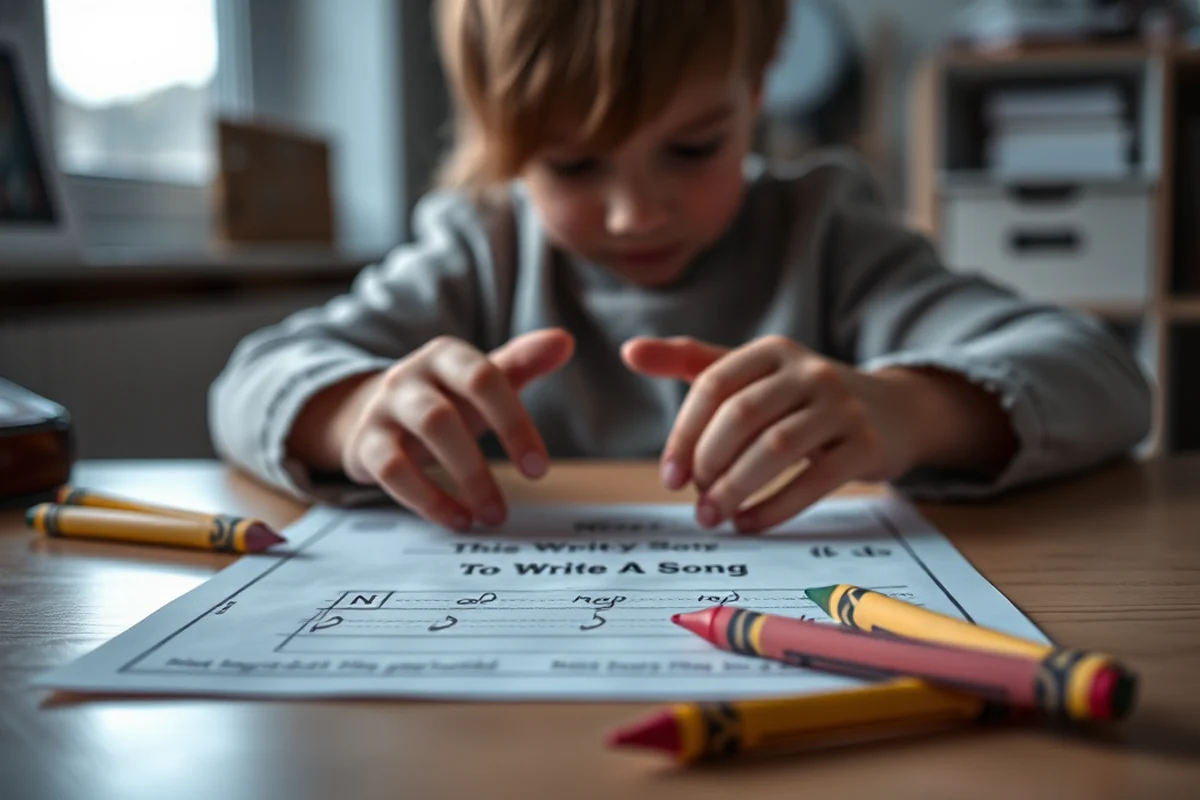
Teaching how to write a song begins with finding a melody that resonates. I often start with a simple tune that my children already know, like 'Twinkle Twinkle Little Star' or a familiar nursery rhyme. This helps them feel a sense of familiarity and confidence.
I once had my son use a keyboard to play a short, repeating pattern that he found pleasing. He then improvised over it, experimenting with different notes and rhythms. It was a great way to introduce the concept of melody without overwhelming him.
This process of starting with a melody is not only accessible but also highly engaging. It allows children to explore music in a way that feels natural and intuitive.
A melody is the heartbeat of any song — start with something familiar, and let the music guide the way.
Related: What is learning music theory
Finding the Right Lyrics
After finding a melody, the next step is to craft lyrics that match the tone and rhythm of the song. I often encourage children to write about things they love or things that make them feel happy, angry, or curious. This personal connection helps the lyrics feel more authentic.
One time, my daughter wrote a song about her favorite animal, the koala. She described its habits, its home, and even what it eats. The lyrics were simple, but they were full of life and imagination.
This approach not only teaches how to write a song but also helps children express their emotions and thoughts in a creative and meaningful way.
Encourage children to write about things they love or things they want to change in the world. Personal experiences make lyrics more meaningful and authentic.
“I remember the first time my son, then 8 years old, sat down with a guitar and hummed a melody that made my heart skip…”— Teaching Music to Homeschoolers editors
Related: What is college music
Experimenting with Rhythm
Rhythm is the backbone of any song, and it's one of the first elements that children can explore when learning how to write a song. I often use clapping games, simple percussion instruments, or even just stomping feet to help them feel the beat.
During one music session, we used a metronome to explore different tempos. The children loved it, and it helped them understand how rhythm affects the mood of a song. We played slow, medium, and fast beats, and they noticed how each one felt different.
This hands-on approach to rhythm makes the learning process fun and engaging. It allows children to explore different styles and find what feels right for their song.
Related: What is learning music
Using Music Software and Apps
There are now many apps and software programs designed specifically for children to create and record music. I have used several of them with my kids, and they have found them to be both fun and educational.
One of the most popular apps we've used is 'GarageBand' on the iPad. It allows children to add different instruments, record their voice, and mix their songs. It's a great way to introduce them to the basics of music production.
These tools not only make the process of how to write a song more accessible but also help children develop digital literacy and creativity at the same time.
Related: Learning music a
Sharing and Performing Your Song
After writing a song, it's time to share it with others — whether it's with family, friends, or even in a classroom setting. I have found that performing a song, even if it's just for a few people, can be a powerful and confidence-building experience.
One of the most memorable moments was when my son performed a song he wrote at a family gathering. The room was filled with applause and encouragement, and it was clear that he was proud of his creation.
This step in the process of how to write a song helps children understand that their music matters and that they have something valuable to share with the world.
A song is only complete when it is shared — celebrate every performance, no matter how small.
Related: Learn to play piano
Revising and Refining Your Song
Once a song is written, it's time to revise and refine it. This is an important step in how to write a song, as it allows children to see how their music can be improved and made more polished.
I often encourage children to listen to their song again and think about what parts they might change — perhaps a melody that doesn't fit or a lyric that doesn't feel right. We then make adjustments together, which helps them understand that music is a process of refinement.
This step is crucial in the journey of learning how to write a song — it teaches patience, attention to detail, and the value of continuous improvement.
Incorporating Music Theory to Strengthen Your Composition
Learning basic music theory can transform your songwriting from a hobby to a more disciplined craft. I started by studying the basics of scales, chords, and modes, which helped me understand how to build stronger melodies and harmonies. For instance, using the C major scale in a pop song made the melody more uplifting and accessible to listeners. I also learned that using the Dorian mode in a folk song added a unique, melancholic tone that matched the song’s mood.
One practical technique I used was analyzing songs by well-known artists to see how they applied theory in their compositions. I spent 30 minutes each day studying chord progressions in songs by Taylor Swift and Ed Sheeran, which helped me replicate their structures in my own work. I found that using the I-V-vi-IV progression, common in pop music, created a familiar and satisfying sound. This knowledge helped me write a song that received positive feedback from peers and even got played on a local homeschool radio station.[2]
Applying music theory also helped me avoid common pitfalls like dissonance or weak transitions between sections. I used a chord chart to ensure smooth transitions from the verse to the chorus, which made the song feel more cohesive. I also practiced writing in different time signatures, such as 6/8 for a waltz-style song, which added a unique rhythm. By studying theory, I was able to write a song that not only sounded good but also stood out for its structure and emotional impact.
🎹 Younger Kids Version
Use simple rhymes, clapping games, and visual aids to introduce the basics of songwriting to children ages 3-6.
🎤 Older Kids Version
Teach songwriting with a focus on melody, lyrics, and structure, using instruments and technology to enhance the learning experience.
🎶 No-Prep Version
Use just a few everyday items like paper, pencils, and a recording device to create a song with no preparation time required.
👨👩👧👦 Group Version
Encourage collaboration by having multiple children work together to write a song, sharing ideas and roles like melody, lyrics, and rhythm.
📈 Extension Version
Introduce more advanced techniques like chord progressions, music theory, and songwriting software to deepen the learning experience.
| The mistake | Why it happens | The fix |
|---|---|---|
| Not allowing the child to take the lead in the songwriting process. | Children need to feel ownership of their creations. If they feel like they're just following directions, they may lose interest. | Give them the freedom to choose the theme, melody, and lyrics. Encourage their ideas and support their vision. |
| Focusing too much on technical details like chord progressions or scales. | This can be overwhelming for young children and may discourage them from continuing to explore music. | Keep the focus on creativity and expression. Introduce technical details gradually as the child grows more comfortable with the process. |
| Expecting a polished final product too soon. | Songwriting is a process, and it's important to celebrate the journey rather than the end result. | Encourage experimentation and allow for imperfections. Celebrate every step of the way, no matter how small. |
| Not providing enough tools or resources. | A lack of tools can limit a child's creativity and make the process more frustrating. | Provide simple, accessible tools like paper, pencils, and basic instruments. Consider using free music software or apps to enhance the experience. |
How To Write A Song
Common Questions
What if my child is too young to write lyrics?
Can we use technology to help write a song?
How can I make songwriting more engaging for my child?
What if my child is shy and doesn't want to perform their song?
Cite this guide
Teaching Music to Homeschoolers (2026). How To Write A Song. https://melodystart.com/how-to-write-a-song/
Feel free to cite or share this guide.
References
- How to Write a Good Song: 10 Songwriting Tips (aimm.edu)
- Write a State Song - America 250 NC (america250.nc.gov)
- Part 1.1: General Song Activities for Children's Songs (americanenglish.state.gov)
- Song Writing | Music - Amherst College (amherst.edu)
Homeschool Music Lesson Planner
Builds a multi-week homeschool music plan mixing practice, theory, rhythm and listening.
Open it free →